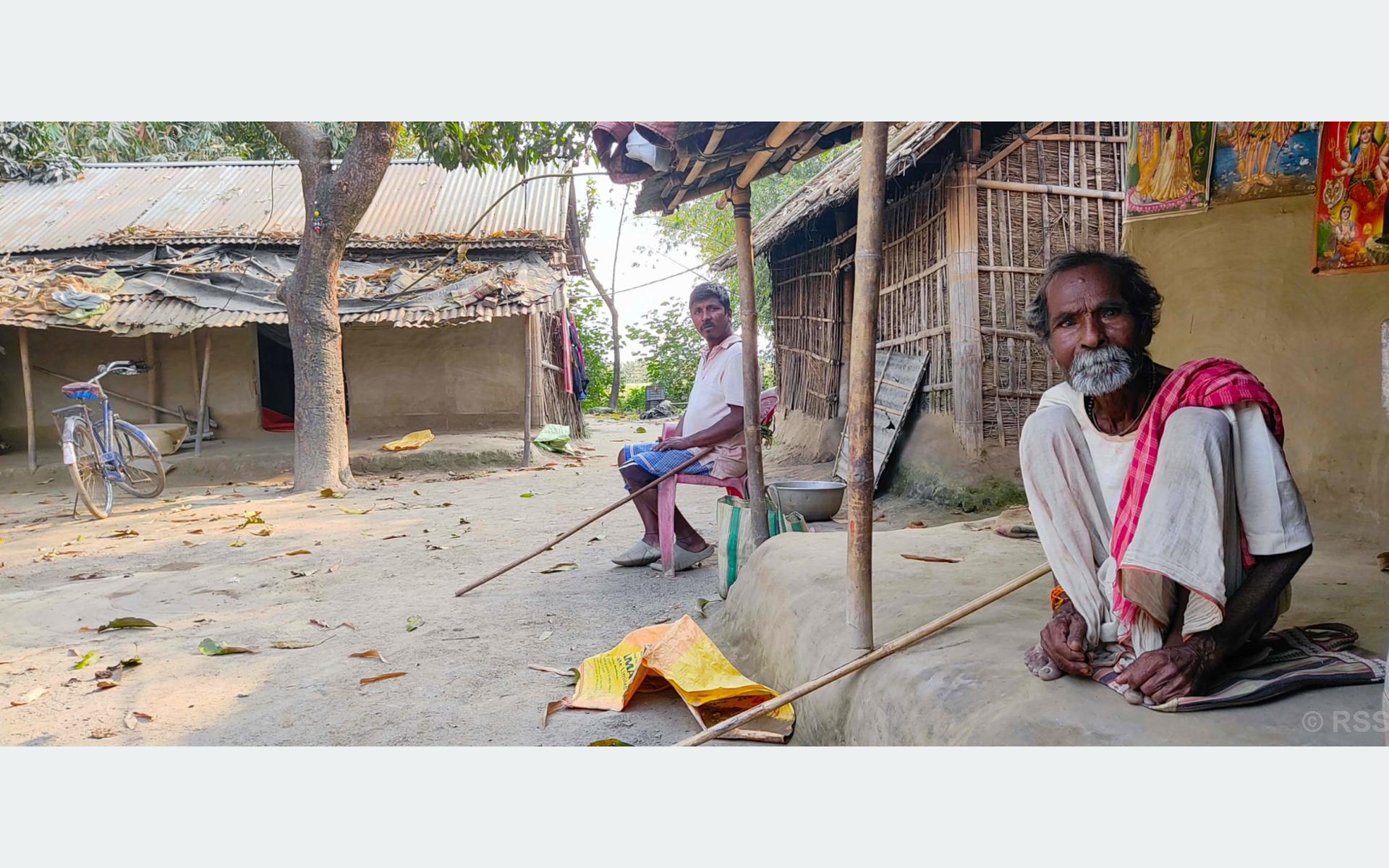
Jhapa, Nepal – Nepal’s eastern border is defined by the Mechi River. But for residents of Gwalabasti, Hopna Basti and Shishau Dangi in Ward-15 of Mechinagar, the river is more than a boundary — it is a barrier that has left them feeling cut off from the rest of the country.
Locals often refer to their settlements as “Nepal across the Mechi.” With no bridge over the river, the three villages have effectively become an island. For 34 years, residents have been demanding the construction of a bridge to connect them with the mainland, but their pleas have gone unanswered.


According to 82-year-old Rajendra Yadav, political leaders only appear during election season, offering promises that are never fulfilled. “Across the country, election campaigns are in full swing — vehicles, flags and campaign songs echo from cities to remote villages,” he said. “But here, east of the Mechi River, there is an eerie silence. No candidate has stepped into our village this time.”
Yadav says he has witnessed many political changes and voted in numerous elections throughout his life. Yet he has never seen such indifference. “During past elections, there was excitement. Leaders came and made big promises. This time, there is no discussion, no visit. We feel invisible despite being within Nepal.”
Home to more than 150 families, the area is primarily inhabited by members of the Rajbanshi, Santhal and Yadav communities. Fertile land allows farmers to grow rice, maize and wheat, along with commercial crops such as vegetables, melons and groundnuts. Despite economic hardship, residents are known for their hard work and agricultural productivity.
Fifty-year-old Saily Tudu remains busy harvesting potatoes in her sandy fields, largely untouched by the election wave. She has heard that voting is scheduled for the 21st of Falgun but does not know the candidates, their election symbols, or voter education details. “Maybe the leaders avoid our village because the road is difficult and they have to walk across the riverbed,” she said. “In past elections, they repeatedly promised to build a bridge. This time, no one has even come to lie.”
The absence of a bridge over the Mechi River remains the community’s greatest shared hardship. Though the river marks the Nepal–India border near boundary pillar 94/1, Nepali settlements lie on the far side of the river. During the monsoon, flooding completely severs their connection with the rest of Nepal.
“We have demanded a bridge in every election for 34 years,” Yadav said. “Leaders promise a suspension bridge, but after they win, we must wait for the next election to remind them again.”
The impact is visible in education and healthcare. During the rainy season, a local primary school can remain closed for up to three months because teachers cannot cross the swollen river. As a result, children are deprived of schooling.
In the absence of reliable services, many children attend schools across the border in India’s West Bengal state. Local resident Pradeep Mukhiya said his youngest son transferred from a Nepali school to a mission school in India due to frequent disruptions. “When heavy rain comes, teachers cannot reach our village. So we go to school in India,” his son Najit explained. Most children in the settlement rely on Indian schools after Grade 2.
Healthcare access is even more alarming. Two years ago, Yadav’s son suffered a stroke. Without a bridge, transporting him to hospitals in Bhadrapur or Dhulabari was nearly impossible. “If we had been able to reach the provincial hospital in time, maybe my son would have recovered,” Yadav said tearfully. “Now he cannot move his limbs. We feel like stateless citizens.”
Land ownership is another persistent concern. Though families have cultivated the land for generations, most lack official land ownership certificates. Living on public land, they fear displacement by either the state or the shifting river. Two decades ago, around 500 families lived here, but many have migrated to India due to the absence of land rights and development prospects.
While electricity has recently reached Gwalabasti, some homes in Hopna Basti still rely on kerosene lamps. Drinking water comes from self-installed tube wells, and irrigation depends on privately purchased generators. Despite repeated requests to local ward offices and municipal authorities for deep boring systems and improved infrastructure, residents say they have received only assurances.
“No one from our villages has secured a government job or gone abroad for employment,” Pradeep said, expressing concern about limited opportunities for youth.
As another election approaches, residents of these three marginalized villages ask a simple question: “Are we not citizens of this country? If we are, where is the road that allows an ambulance to reach our homes? Where is the suspension bridge to cross the Mechi during floods? Where is irrigation for our fields and access to secondary education in Nepali?”
Elections come and go, but their struggles remain unchanged. More than political ideology, the people here seek a representative with the will and determination to finally build a bridge over the Mechi River — and connect them, in practice as well as on paper, to the nation they call home.