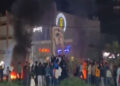
The Taliban have opened fire in the air to disperse protesters in the Afghan capital, Kabul.
A video shot at the scene shows gunshots and people fleeing to safety.


Thousands of protesters on the streets of Kabul on Tuesday denounced the Taliban regime, demanding that women’s rights be protected.
They also chanted slogans against Pakistan.
Many believe that neighboring Pakistan has backed the Taliban. But Pakistan has denied the allegations.
A video sent to the BBC shows Taliban fighters firing into the air.
The Taliban banned firing in the air last year after some people were killed in celebrations of a return to Taliban rule.
The BBC team and some journalists were barred from taking pictures and videos of the rally in Kabul.
According to Tolo, an Afghan news agency, a cameraman and other local and foreign journalists have been arrested.
Last year, women took to the streets in Afghanistan to protest against the Taliban.
On Tuesday, men also expressed solidarity, demanding equality and protection for women.
Citizens staged a massive demonstration in Kabul the day after a leader of a group fighting the Taliban regime in the Panjshir Valley called for a “nationwide uprising” against the Taliban.
A large number of young women participated in the demonstration.
According to the BBC’s Alexander Karmani, the protesters appeared angry with the Taliban and Pakistan.
According to Karmani, the Taliban fighters in the police vehicle had earlier walked with the protesters and they did not stop protesting.
“But later they fired into the sky to disperse the crowd and did not allow us and other journalists to capture the scene,” he said.
The Taliban have said they can involve women in government but not ministers.
Speaking at a news conference on Monday, a Taliban spokesman said Panjshir was under their control.
And they tried to reassure the people by calling them “brothers.”
The Taliban took control of Afghanistan three weeks ago.
He took control of the capital, Kabul, on August 15.

Surrounded by steep mountains, the Panjshir Valley is home to between 1.5 million and 200,000 people.
Earlier, when the Soviet Union and the Taliban took control of Afghanistan, Panjshir was not under their control.
There was resistance against the Soviet army in the 1980s and from 1996 to 2001.

In an audio message posted on social media on Monday, NRF leader Ahmed Masood called for a nationwide uprising against the Taliban.
He said his army had been attacked by militants and members of his family had been killed on Sunday.
He accused the international community of legitimizing the Taliban and helping to boost military and political confidence.
In the 1980s, there was resistance in Panjshir against the Soviet army and from 1996 to 2001.
Ahmed Masood, a local tribal leader, is now leading the fight against the Taliban. Earlier, his father had opposed the Soviet army and the Taliban.
But he was assassinated two days before 9/11.

Major events in the 20-year Afghan conflict
- October 7, 2001: US-led coalition bombed Taliban and al-Qaeda bases in Afghanistan. Attacks on Kabul, Kandahar and Jalalabad targets after the Taliban, who came to power after a decade of Soviet rule and subsequent civil war, refused to hand over al-Qaeda leader Osama bin Laden to the United States.
- November 13, 2001: Kabul is captured by The Northern Alliance, an allied anti-Taliban insurgent group.
- February 7, 2009: Significant increase in the number of troops deployed to Afghanistan by US President Barack Obama. At one time, the number of troops had reached 140,000
- December 2014: NATO announces end to its military operations in Afghanistan. After that, thousands of troops were repatriated by the United States. Most of the troops stationed there are focused on training and assisting Afghan security forces
- February 29, 2020: US and Taliban sign a “peace agreement” in Doha, Afghanistan. The combatants complied with the agreement, with US and NATO partners pledging to withdraw all troops within 14 months.
- April 13, 2021: US President Joe Biden announces the withdrawal of all US troops from Afghanistan by September 11.
- August 16, 2021: The Taliban seize key Afghan cities and towns, including Kabul, in just over a month. Afghan security forces fail in front of Taliban
- August 31, 2021: US announces completion of troop withdrawal from Afghanistan
The Afghan girl was sent inside the chaotic Kabul airport
Rise to power of the Taliban
In Pashto, Taliban means “students.”
They emerged from northern Pakistan in the 1990s following the withdrawal of Soviet troops from Afghanistan.
The Pashtun movement is believed to have originated with a religious group that received financial support from Saudi Arabia, a stronghold of Sunni Islam.
The Taliban have vowed to restore peace and enforce Sharia law in the Pashtun-dominated areas of Afghanistan and Pakistan.
The Taliban quickly expanded its influence from southwestern Afghanistan.
In September 1995, they captured the province of Herat, which borders Iran.
Exactly one year later, they took control of the capital, Kabul, and overthrew the government of President Burhanuddin Rabbani.
He was one of the founders of the Afghan Mujahideen against the Soviet invasion.
By 1998, the Taliban controlled about 90 percent of the territory.

Afghans, disillusioned with the mujahedeen after the Soviet withdrawal, initially welcomed the Taliban who had moved forward for the first time.
He gained popularity by taking steps against corruption, reducing lawlessness, building roads for business to flourish, and providing security in self-regulated areas.
But the Taliban enforced or upheld the strict interpretation of Sharia law – for example, the death penalty for murderers and adulterers and the amputation of thieves’ hands.
During his reign, men were required to grow beards and women were required to wear full-length burqas.
The Taliban have banned television, music and cinema, and said teenagers aged 10 and over should not be allowed to go to school.
Who lost their lives in the Afghan war?
They are accused of various human rights violations and cultural abuse.
One of the worst examples was the international outcry in 2011 when they set out to destroy a statue of the famous Bamiyan Buddha in central Afghanistan.
Pakistan has consistently denied being a Taliban facilitator.
But there is little doubt that many Afghans who initially joined the Taliban are studying in madrassas in Pakistan.
Apart from Saudi Arabia and the United Arab Emirates, Pakistan was the only country to recognize the Taliban when they were in power.
Pakistan was also the last country to sever diplomatic ties with the Taliban.
At one point, the Taliban threatened to destabilize Pakistan from the northwest it controlled.
There was one incident that was widely condemned internationally – an attack by the Pakistani Taliban in October 2012 when schoolgirl Malala Yousafzai was returning to her hometown of Mingora.
The group’s influence in Pakistan waned after a major military operation two years after a school massacre in Peshawar, Pakistan.

At least three people, including Pakistani Taliban leader Hakimullah Mehsud, were killed in a US drone strike in 2013.
Following the September 11, 2001, attacks on the World Trade Center in New York, the world’s attention was drawn to the Afghan Taliban.
The Taliban have been accused of protecting Osama bin Laden and his group al-Qaeda, the main suspects in the attack.
On October 7, 2001, US-led coalition forces began invading Afghanistan.
And by the first week of December, the Taliban had been defeated